Review
Field Watch vs Smartwatch for Motorcycle Riders: Which Is Better in 2026?
By Stef Zeps · The Gear Post · 2026-07-20
A rider-focused comparison of three watch categories — mechanical field watch, rugged GPS watch and full smartwatch — and when each one actually earns its place on a motorcycle.
Quick comparison
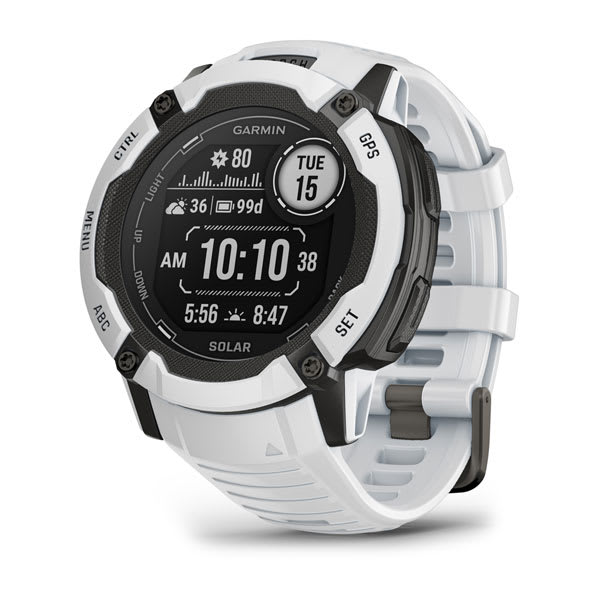
- Garmin Instinct 2 SolarMSRP $449.99
Instinct 2S Solar 40mm Graphite; the 45mm Instinct 2 Solar is a separate listing.
- Best for
- Touring and adventure riders who want GPS and multi-week battery life with glove-friendly buttons
- Type, controls & battery
- multi-band · 100 m · solar / unlimited · MIL-STD-810
- Verdict
- Rugged GPS watch with solar charging and multi-band GNSS.
- Apple Watch Ultra 3MSRP $799
Amazon ASIN B0FQG8X3RH: GPS + Cellular, 49mm Natural Titanium case with Anchor Blue Ocean Band. Black Titanium cases and Alpine/Trail/Milanese bands are separate listings and can price differently.
- Best for
- Riders in the Apple ecosystem who want navigation, 5G and satellite SOS on the wrist
- Type, controls & battery
- Dual-frequency L1 + L5 · 49 mm titanium · 100 m (EN13319 dive rated) · Up to 42 h (72 h low power)
- Verdict
- Titanium adventure smartwatch with satellite messaging, 5G and a 3,000-nit always-on display.
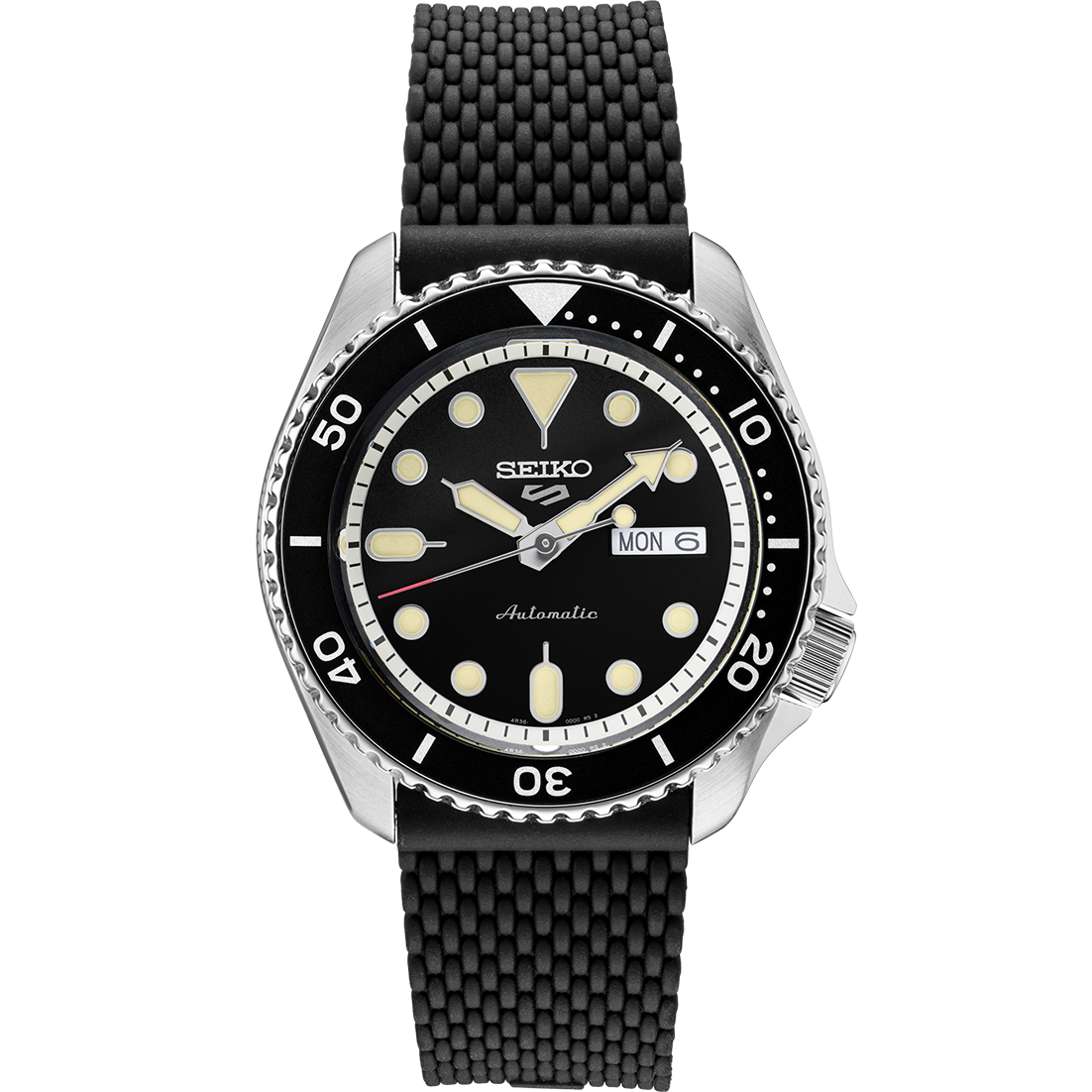
- Seiko 5 Sports SRPD95MSRP $350
Amazon ASIN B07ZJSVFZF: Seiko 5 Sports SRPD95, black dial on black-ion bracelet. Other SRPD dial/strap references sit on separate listings at different prices.
- Best for
- Riders who want a durable, no-charging watch and already handle navigation and comms on the bike
- Type, controls & battery
- 100 m · Hardlex · 42.5 mm · automatic
- Verdict
- Automatic field watch with day-date and 100 m water resistance.
| Product | Best for | Type, controls & battery | Our verdict | MSRP | Link |
|---|---|---|---|---|---|
| Garmin Instinct 2 SolarInstinct 2S Solar 40mm Graphite; the 45mm Instinct 2 Solar is a separate listing. | Touring and adventure riders who want GPS and multi-week battery life with glove-friendly buttons | multi-band · 100 m · solar / unlimited · MIL-STD-810 | Rugged GPS watch with solar charging and multi-band GNSS. | MSRP $449.99 | Check price on Amazon |
| Apple Watch Ultra 3Amazon ASIN B0FQG8X3RH: GPS + Cellular, 49mm Natural Titanium case with Anchor Blue Ocean Band. Black Titanium cases and Alpine/Trail/Milanese bands are separate listings and can price differently. | Riders in the Apple ecosystem who want navigation, 5G and satellite SOS on the wrist | Dual-frequency L1 + L5 · 49 mm titanium · 100 m (EN13319 dive rated) · Up to 42 h (72 h low power) | Titanium adventure smartwatch with satellite messaging, 5G and a 3,000-nit always-on display. | MSRP $799 | Check price on Amazon |
| Seiko 5 Sports SRPD95Amazon ASIN B07ZJSVFZF: Seiko 5 Sports SRPD95, black dial on black-ion bracelet. Other SRPD dial/strap references sit on separate listings at different prices. | Riders who want a durable, no-charging watch and already handle navigation and comms on the bike | 100 m · Hardlex · 42.5 mm · automatic | Automatic field watch with day-date and 100 m water resistance. | MSRP $350 | Check price on Amazon |
Prices shown are manufacturer list prices (MSRP) for reference only — retail prices change often. The buy button opens the named retailer’s listing, where the current price is shown.
Some links on this page are affiliate links. If you make a purchase, we may earn a commission at no additional cost to you. Our recommendations are editorially independent.
Why a watch is different on a motorcycle
Off the bike, a watch is jewellery with a clock in it. On the bike, it is a device competing for attention with traffic, mirrors, a mounted phone and possibly an intercom talking in your ear. That changes what matters. The first question is not how many features a watch has, it is how much of your attention it costs to use.
Glanceability comes first. Checking the time or a distance-to-turn should be a fraction of a second inside a scan you were already making. A dial with real hands and clear markers does that well. So does a large always-on display. What does not do it well is a watch that needs you to raise your wrist, wait for a screen to wake, then squint at a stack of small type at 110 km/h.
Then there is the hardware you are wearing. Gloves and jacket cuffs make a mess of touchscreen interaction: a gauntlet cuff can cover the display entirely, and most riding gloves are either not touch-conductive or only conductive at one fingertip, which is fine for accepting a call and useless for anything else. Physical buttons survive gloves far better than glass does.
Vibration and weather are less of a problem than forum lore suggests. Modern automatic movements are shock-protected and are not damaged by normal engine or road vibration; sustained high-frequency vibration is a concern for precision instruments, not for a 100 m-rated sports watch on a wrist that is partly isolated by your arm. Water resistance and a scratch-resistant crystal matter more day to day.
Charging is where the categories really separate. On a multi-day tour you may already be feeding a phone, an intercom, an action camera and a GPS every night. Adding one more charger is not a catastrophe, but it is one more cable, one more thing to forget in a hotel, and one more device that can be flat when you need it. There is a genuine appeal to a watch that keeps working whether or not you remembered anything.
Finally, overlap. Wrist GPS, notifications and turn prompts are useful — but if you already run a cockpit GPS or a mounted phone, you may be paying a premium for a second copy of features you can already see on a bigger screen. More technology is not automatically better. The right watch is the one that adds something your existing setup does not already do.
The three approaches
**Mechanical field watch — Seiko 5 Sports SRPD95.** An automatic movement wound by your wrist, a 42.5 mm case, Hardlex crystal and 100 m water resistance. No charging routine, no pairing, no firmware. It tells the time, day and date, and it will still do that on day nine of a trip when everything else is queued at the one available wall socket. If you want the same no-charging proposition in the SKX-style diver shape, the Seiko 5 Sports SRPE is the SRPD95's sibling — same 4R36 family and 100 m rating, with a rotating bezel and steel bracelet. The limitations are exactly what you would expect: no GPS, no notifications, no crash detection or emergency connectivity, no navigation help, and mechanical accuracy measured in seconds per day rather than the effectively perfect timekeeping of anything synced to a phone. That is a fair trade for some riders and a dealbreaker for others — it is not inherently the purer choice, just the simpler one.
**Rugged GPS watch — Garmin Instinct 2 Solar.** The middle ground. Multi-band GNSS, MIL-STD-810 construction, 100 m water resistance, five physical buttons and a low-power monochrome display that stays readable in direct sun. Because that display costs almost nothing to run, battery life is measured in weeks of ordinary use rather than a day or two, and solar exposure extends it further. Be clear-eyed about what solar means: it lengthens the interval between charges depending on how much bright light the watch actually sees, which for a rider is usually a lot. It does not mean you never plug it in.
**Full smartwatch — Apple Watch Ultra 3.** A 49 mm titanium case, a 3,000-nit always-on display, dual-frequency L1 and L5 GPS, 5G cellular, satellite SOS and 100 m water resistance to EN13319 dive standard, with Apple rating up to 42 hours of normal use and 72 hours in low power mode. What the complexity buys is genuine: turn prompts and calls without the phone in your hand, an enormous readable screen, emergency and messaging features where the network or satellite service is available, and a watch that is fully useful off the bike as well. What it costs is a daily-ish charging habit, the highest price of the three, deep dependence on an iPhone and the Apple ecosystem, touchscreen-first interaction that gloves fight, and heavy overlap with a mounted phone or dedicated GPS. Treat the satellite and emergency features as conditional on coverage and account status, not as a guarantee, and never as a substitute for telling someone your route and carrying what you need to sit out a breakdown.
The rider comparison
| Seiko 5 Sports SRPD95 | Garmin Instinct 2 Solar | Apple Watch Ultra 3 | |
|---|---|---|---|
| Type | Automatic mechanical | Rugged GPS watch | Full smartwatch |
| Controls | Crown, no screen | Five physical buttons | Touchscreen + buttons |
| GPS | None | Multi-band GNSS | Dual-frequency L1 + L5 |
| Connectivity | None | Phone notifications | 5G cellular + satellite SOS |
| Charging | None (wrist-wound) | Weeks, solar-extended | Up to 42 h (72 h low power) |
| Water resistance | 100 m | 100 m | 100 m (EN13319) |
| Navigation role | No role | Backup and off-bike | Backup to cockpit screen |
| Rider advantage | Nothing to manage | Endurance with glove-friendly buttons | Connectivity and a huge display |
| MSRP | $350 (Seiko) | $449.99 (Garmin) | $799 (Apple) |
Type
- Seiko 5 Sports SRPD95
- Automatic mechanical
- Garmin Instinct 2 Solar
- Rugged GPS watch
- Apple Watch Ultra 3
- Full smartwatch
Controls
- Seiko 5 Sports SRPD95
- Crown, no screen
- Garmin Instinct 2 Solar
- Five physical buttons
- Apple Watch Ultra 3
- Touchscreen + buttons
GPS
- Seiko 5 Sports SRPD95
- None
- Garmin Instinct 2 Solar
- Multi-band GNSS
- Apple Watch Ultra 3
- Dual-frequency L1 + L5
Connectivity
- Seiko 5 Sports SRPD95
- None
- Garmin Instinct 2 Solar
- Phone notifications
- Apple Watch Ultra 3
- 5G cellular + satellite SOS
Charging
- Seiko 5 Sports SRPD95
- None (wrist-wound)
- Garmin Instinct 2 Solar
- Weeks, solar-extended
- Apple Watch Ultra 3
- Up to 42 h (72 h low power)
Water resistance
- Seiko 5 Sports SRPD95
- 100 m
- Garmin Instinct 2 Solar
- 100 m
- Apple Watch Ultra 3
- 100 m (EN13319)
Navigation role
- Seiko 5 Sports SRPD95
- No role
- Garmin Instinct 2 Solar
- Backup and off-bike
- Apple Watch Ultra 3
- Backup to cockpit screen
Rider advantage
- Seiko 5 Sports SRPD95
- Nothing to manage
- Garmin Instinct 2 Solar
- Endurance with glove-friendly buttons
- Apple Watch Ultra 3
- Connectivity and a huge display
MSRP
- Seiko 5 Sports SRPD95
- $350 (Seiko)
- Garmin Instinct 2 Solar
- $449.99 (Garmin)
- Apple Watch Ultra 3
- $799 (Apple)
**Gloves and controls.** Buttons win. The Instinct can be operated with a gloved hand without much thought; the Ultra 3 has a customisable Action button and a digital crown that help, but anything beyond that means glass. The Seiko sidesteps the problem entirely by having nothing to press. Whichever you wear, set it up before you ride. Configuring screens, dismissing notifications or scrolling a route on your wrist is not something to do while the bike is moving — pull over.
**Battery math for touring.** This is practical power management, not battery anxiety. A mechanical watch adds nothing to the pile. A GPS watch adds a charge every week or two, and solar stretches that if you ride in daylight. A smartwatch joins the nightly queue alongside your phone, intercom and camera — fine at hotels, more annoying when you are camping or covering long distances between reliable power. If your bike has a USB outlet and you stop regularly, none of this is a problem; if it does not, it is worth thinking about before you buy.
**Navigation.** Wrist navigation is a useful backup and a genuinely good way to follow a walking route once you are off the bike, but a 1.4-inch display is not a substitute for a proper cockpit setup. If routing matters to you, solve it there first with a dedicated motorcycle GPS or a properly secured phone mount, then let the watch complement it — buzzing a turn you might have missed, or holding a track when the main screen is off.
**Communications.** A watch that taps your wrist for an incoming call is useful; a watch that shows you a paragraph of text is a hazard. Audio through an intercom handles nearly everything better than a screen does, because it does not ask for your eyes. Configure notifications aggressively: calls and navigation through, everything else silenced until you stop.
**Cockpit technology.** The watch is one item in a list that may already include a phone, an intercom, a GPS and an action camera. Every added device is another thing to power, mount and think about. That is the strongest argument for the simplest watch you can be happy with.
Seiko 5 Sports SRPD95 — best for simplicity
It earns its place by being the one pick that asks nothing of you. Wear it, ride, and it works. The 42.5 mm case sits reasonably under most cuffs, 100 m water resistance covers any weather you would ride in, the day-date is genuinely useful on a long trip, and the automatic movement means there is no battery to die and no charger to pack.
The limits are real. There is no GPS, no notification, no emergency function and no way for it to help you find anything. Mechanical accuracy drifts, so you will reset it against your phone occasionally. And a steel bracelet on a hot day is a hot bracelet.
Buy it if your navigation and communications are already sorted on the bike and you want a durable, conventional watch that never becomes a chore. Skip it if you want any electronic function at all — buying a mechanical watch and then wishing it did more is the most common way to be disappointed by one. Verdict: the low-maintenance choice, and the best value of the three if you do not need features.
Garmin Instinct 2 Solar — best balance for adventure and touring
This is the pick that suits the largest number of riders. It gives you real GPS and outdoor functionality, rugged MIL-STD-810 construction and 100 m water resistance, and it does it behind five physical buttons that work with gloves. Because the display is low-power rather than bright and colourful, the battery lasts on a scale that fits touring, and solar exposure pushes it further.
The trade-offs are aesthetic and functional. The monochrome screen looks utilitarian and reads maps poorly compared with a phone or a smartwatch. Notification handling is basic. It is a Garmin-ecosystem device, so getting value out of the data means using Garmin's app.
Buy it if you tour, ride adventure or spend time away from power, and you want GPS and endurance without your wrist becoming a second phone. Skip it if you mostly commute in a city, already navigate from a mounted phone and would rather have a nicer-looking watch. Verdict: the sensible middle, and the one that behaves best in gloves.
Apple Watch Ultra 3 — best connected option
The Ultra 3 is the most capable device here and the most demanding. The 3,000-nit always-on display is the easiest of the three to read in bright sun, dual-frequency GPS is precise, 5G means it works with the phone in a pocket or a tank bag, and satellite SOS plus messaging add a safety layer where they are supported. Off the bike it is a full smartwatch, which is a real part of its value.
Against that: $799 MSRP, a charging habit measured in hours rather than weeks, a hard requirement for an iPhone, touchscreen-first interaction that gloves make awkward, and a feature set that duplicates much of what a mounted phone already shows you on a bigger screen. Its emergency features depend on coverage and service availability and should be treated as one layer of preparation, not the plan.
Buy it if you are already an iPhone rider who wants connectivity, health tracking and emergency features and is happy to charge nightly. Skip it if battery independence matters more to you than connectivity, or if you are on Android — where it is simply not an option. Verdict: the most watch, for riders who will actually use the parts that cost the most.
Which one should you buy?
**Choose the Seiko if** you want reliable basic timekeeping, refuse to add another charger to the pile, and already have navigation and communications handled on the bike.
**Choose the Garmin if** you tour or ride off-pavement, care about battery endurance and GPS, and want controls you can operate with gloves on.
**Choose the Apple Watch Ultra 3 if** you are in the Apple ecosystem and value connectivity, a large bright display and emergency features more than going weeks without a charger.
One more filter before you spend: if you already run a dedicated motorcycle GPS or a well-mounted phone, most of the navigation value of an expensive watch is already on your handlebars. In that case the honest question is whether you want a watch that adds something new — endurance, safety features, off-bike use — or simply a good watch.
Frequently asked questions
**Is a smartwatch actually useful on a motorcycle?** Yes, in narrow ways: a wrist tap for turns or calls, a large readable clock, and ride tracking. It is much less useful as something you read or operate while moving.
**Can a smartwatch replace a motorcycle GPS?** For simple routes and short trips it can get you there, but the small screen, exposure to weather and battery drain make it a poor primary navigation device. Treat it as a backup to a cockpit screen.
**Are touchscreens practical with motorcycle gloves?** Mostly not. Some gloves have conductive fingertips that manage a tap, but reliable interaction with gloves comes from physical buttons. Set everything up before you ride.
**Is a mechanical watch affected by motorcycle vibration?** In normal use, no. Shock-protected modern automatics like the Seiko 5 handle riding vibration fine. Extreme, sustained vibration can affect accuracy over time, but this is not a practical concern for ordinary riding.
**How important is battery life for touring?** It depends on your charging situation. If you stop nightly at hotels with outlets, a smartwatch is fine. If you camp, cover long distances, or already charge a phone, intercom and camera every night, a watch that lasts weeks is worth a lot.
**Is the Garmin Instinct 2 Solar completely solar-powered?** No. Solar charging extends the time between charges — considerably so if the watch gets regular bright light — but the watch still needs to be plugged in periodically, and heavy GPS use shortens the interval.
**Is the Apple Watch Ultra 3 worth it for riders who already use an iPhone?** If you want cellular independence from the phone, satellite SOS where supported, and full smartwatch use off the bike, yes. If you mainly want a rugged watch that tells the time on long trips, the Garmin or the Seiko delivers more of what riding actually asks for, for less money.
**Which type makes the most sense for long-distance touring?** For most tourers, the rugged GPS watch. It gives useful navigation and tracking without joining the nightly charging queue, and its buttons work with gloves. A mechanical watch is the better answer if your cockpit already handles everything electronic.
Prices quoted are manufacturer list prices at the time of writing, not current retail. This guide is based on manufacturer specifications and published owner and press reports rather than controlled testing by The Gear Post.